











For generations of students at Brighton High School, the yearbook has served as more than just a collection of photos—it’s a time capsule. Flipping through its pages reveals not only faces and names but the evolving story of the school itself. From glue sticks and film cameras to digital layouts and 300-page editions, the history of Brighton’s yearbook reflects both technological change and the enduring importance of preserving memories.
Back in the mid-1990s, creating a yearbook looked very different from today. Mr. Sean Carney, now the graphics teacher at BHS, remembers his time on the yearbook staff as both demanding and hands-on in ways that might surprise current students.
”When I was in yearbook in 1994-95, we had computers,” Carney said, “but you couldn’t really get images into them at the high school level.” While students used early design software like Adobe PageMaker, much of the work still relied on physical processes. Photos were taken on rolls of film, developed and then manually arranged.
“We would use a camera to reduce and enlarge things,” he said. “And then we would have to glue things together.”
Every image required careful planning. Staff members would physically mark photos with crop boxes and instructions for how large they should appear. These directions were sent to printers, who assembled the pages and mailed back proofs for review. The process was slow, and the mistakes were costly.
“The proofing was huge,” Carney said. “They would mail us proofs, and every photo had to be printed. You got what you got—sometimes the ball was in the photo, sometimes it wasn’t.”
Despite these challenges, the dedication of the staff never waivered. Students spent long hours after school and on weekends to meet deadlines.
“We would be here after school, on weekends,” Carney said. “The yearbook back in the day was significantly harder to produce.”
Even the timeline differed. While today’s yearbooks are typically distributed before the school year ends, older editions often required the supplement be sent out in fall to capture events that happened late in the year due to the slower printing process.
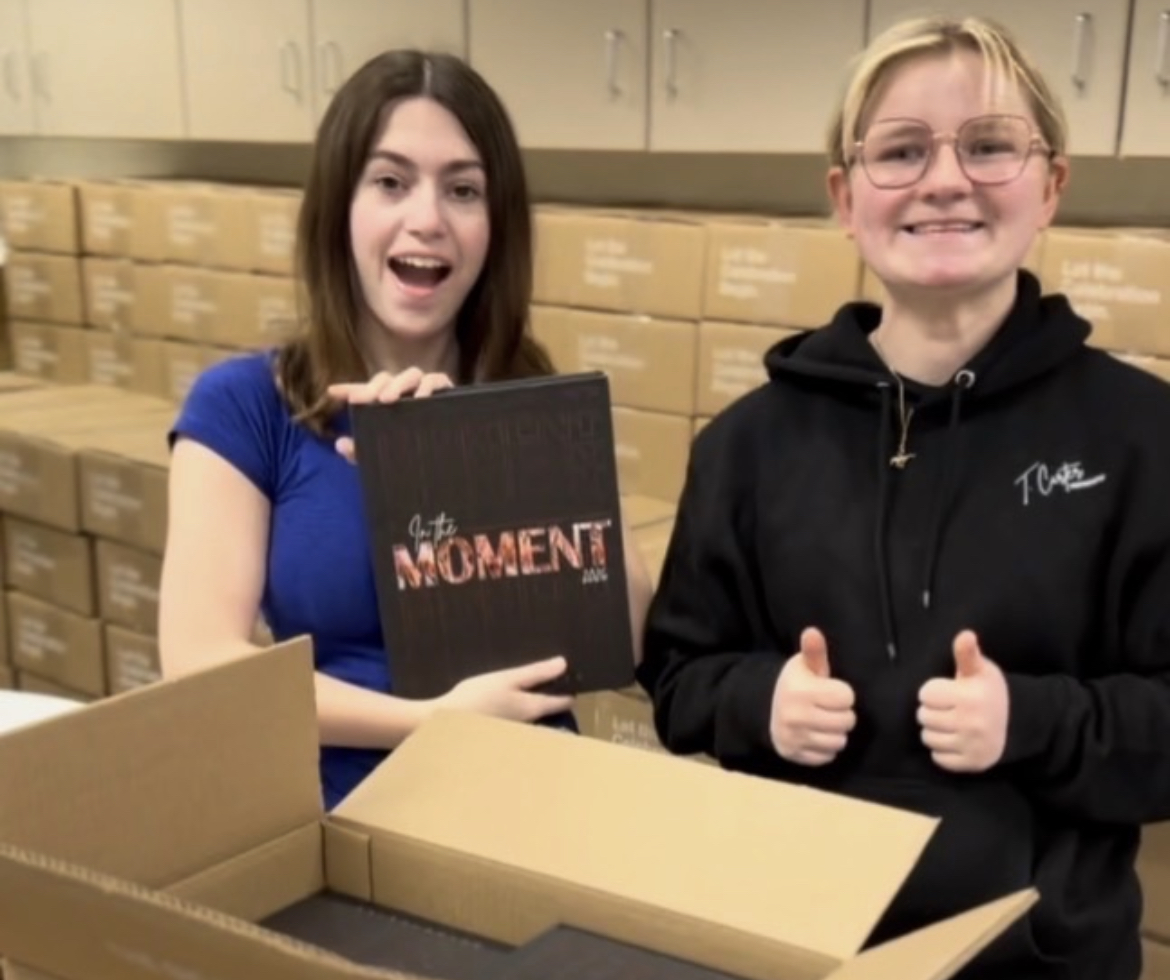
Fast forward to today, and the yearbook has transformed into a much more streamlined and expansive production. Senior editor-in-chief Tessa Carter has witnessed these changes firsthand during her three years on staff.
“Over the years, the yearbook has obviously grown in size,” Carter said. “Now [it’s] 300+ pages, which allows us to cover many more groups as well as cover each in a more substantial way.”
Advancements in technology have made design more efficient and flexible. Programs like Yearbook Avenue allow students to create and edit layouts entirely online, eliminating the need for physical assembly.
“We don’t have to physically lay out spreads like in Mrs. Christiansen’s youth,” Carter said. “We have improved our design, layout and images overall, especially our use of space.”
Modern yearbooks also aim to be more inclusive. Carney noted that earlier editions often featured the same small group of students repeatedly, whereas today’s staff works to represent a broader range of the student body.
“I think our yearbook class does a pretty solid job… it really shows what happens in the school,” he said. “It’s not the same 10 people in all the photos anymore.”
Still, some challenges remain unchanged. According to Carter, one of the biggest ongoing issues is participation and communication among staff and contributors.
“The biggest problem has always been people not getting their stuff on time or not cooperating in going to events,” she said. “The yearbook is built on communication and cooperation, and when either of those things falters, the whole book suffers.”
Despite the obstacles, both Carney and Carter agreed on the yearbook’s significance. It plays a crucial role in preserving the culture and identity of each school year.
“The photos and quotes speak to the time,” Carter said. “Trends, fashion and world events are most prevalent in the youth, so a yearbook is the perfect way to preserve what was happening at the time.”
Carney echoed this sentiment, emphasizing the value of having a physical record.
“There’s something tangible that is nice to have,” he said. “It’s something that you have forever… you need to have that snapshot in time.”
Looking ahead, the future of yearbooks may include even more changes. Carter predicts that digital formats could eventually become more prominent, possibly incorporating videos and interactive elements. Still, Carney believes printed yearbooks will endure.
”I think they’re always going to be around,” he said. “You might not look at every digital photo you’ve ever taken, but you might look at your yearbook.”
From cut-and-paste layouts to fully digital design platforms, BHS’s yearbook has come a long way. However, its purpose remains the same: to capture the moments, people and stories that define each and every year. In a world that’s constantly changing, the yearbook continues to offer something rare—a lasting, physical reminder of the past. Ultimately, the Brighton High School yearbook has come a long way since the 1990s and will continue to change well into the future.